AI data collection is no longer only about scraping more pages. It is about collecting cleaner, more complete, and more repeatable datasets that can support LLM training, RAG enrichment, market intelligence, SERP monitoring, product analysis, and automated research workflows. Grand View Research values the global AI training dataset market at $3.9 billion, showing that reliable data infrastructure is now essential for AI teams that depend on fresh, diverse, and usable public web data.
Proxy quality affects how much public data AI teams can access, how accurate localized results are, and how often crawlers face blocks, CAPTCHA, missing pages, redirects, or incomplete responses. The right proxy setup helps turn public web data into usable AI input instead of noisy, fragmented, or unreliable crawl output. This guide compares the best proxies for AI data collection based on IP quality, targeting, session control, scalability, pricing, and real business use cases.
The best rotating proxy helps AI crawlers collect public data more consistently across search results, product pages, reviews, directories, ecommerce listings, and market data sources. But rotation alone is not enough. AI teams also need strong IP quality, stable routing, accurate targeting, and clear session logic to avoid noisy or incomplete datasets.
Cleaner public web data: Strong IP quality helps crawlers collect full pages instead of blocked, partial, or distorted responses.
Fewer blocked requests: Reliable proxy infrastructure reduces failed requests, access interruptions, and repeated crawler errors.
Better crawl continuity: Stable routing helps long-running data collection jobs finish without breaking mid-flow.
Lower CAPTCHA pressure: Higher-quality residential and mobile IPs can reduce the number of verification events during recurring crawls.
More accurate localized results: Geo-targeting helps collect SERPs, ecommerce pages, and regional content from the correct market.
Less duplicate or incomplete data: Stronger rotation and session logic reduce noisy crawl output that would otherwise require engineering cleanup.
AI crawlers need stable proxy logic because datasets must be repeatable, explainable, and comparable over time. Randomly changing IPs without a clear session strategy can break multi-page flows, distort location-based results, and create inconsistent records.
Strong proxy logic helps AI teams decide when to rotate, when to keep the same IP, which location to use, and how to separate workflows by source, market, or collection purpose.
AI crawlers often revisit the same pages, queries, categories, or markets on a fixed schedule. Predictable proxy behavior helps teams compare results across time instead of constantly changing collection conditions or rebuilding crawler logic.
Sticky sessions are useful when a crawler needs to move through several pages, maintain the same browsing path, or collect related records from one environment. This is especially important for ecommerce pages, SERPs, carts, filters, pagination, multi-step research flows, and structured data extraction.
Geo-targeting keeps localized datasets cleaner, more reliable, and easier to validate. If an AI team is collecting US SERPs, Canadian pricing, or UK ecommerce listings, the proxy location should match the market being studied to preserve context, rankings, pricing, and regional signals.
Better proxy logic reduces failed requests, duplicate records, missing fields, mismatched locations, broken crawl paths, and inconsistent outputs. That means less time spent cleaning data before training, enrichment, indexing, or analysis, and more confidence in downstream AI-ready datasets overall.

AI teams need to choose proxies based on dataset quality, not only price or advertised IP pool size. The right provider needs reliable access, controlled rotation, accurate targeting, ethical sourcing, and scalable infrastructure for recurring AI data workflows.
IP reputation: Clean IPs reduce blocks, CAPTCHA, redirects, failed requests, and incomplete page loads.
Ethical sourcing: Consent-based networks reduce compliance, legal, and reputational risks for AI data operations.
Proxy infrastructure: Residential proxies support trust-sensitive websites, while mobile proxies support mobile-first SERPs, ads, and app data.
Targeting depth: Country, city, and ASN targeting improve localized SERPs, ecommerce data, ads, and market-specific content.
Session control: Sticky sessions and flexible rotation balance scale, continuity, repeated checks, and multi-page flows.
Scalability: APIs, dashboards, low failure rates, and HTTP/SOCKS5 support simplify AI crawlers, browsers, and automation workflows.
The table below compares the best proxy providers for AI data collection by proxy infrastructure, workflow fit, and AI data use case. It helps teams quickly understand which providers are better suited for SERP monitoring, e-commerce tracking, market research, AI enrichment, large-scale crawling, and repeatable public web data collection.
| Provider | Proxy Infrastructure | Best For | AI Data Use Case |
| 1. Live Proxies | Rotating residential, rotating mobile | Controlled AI data collection workflows | SERP data, ecommerce data, market research, repeatable public web data |
| 2. Oxylabs | Residential, mobile, ISP, datacenter, dedicated datacenter, dedicated ISP | Enterprise-scale public data extraction | Large AI datasets and structured data pipelines |
| 3. IPRoyal | Residential, ISP, datacenter, mobile, enterprise proxies | Flexible AI data collection on a controlled budget | SERP data, ecommerce checks, and smaller scraping workflows |
| 4. Decodo | Residential, mobile, ISP, static residential, datacenter | Flexible AI scraping workflows | SERP data, ecommerce data, market intelligence |
| 5. SOAX | Residential, mobile, US datacenter | Geo-sensitive AI datasets | Local SERPs, regional pricing, market monitoring |
| 6. NetNut | Residential, static residential, mobile, datacenter, rotating residential sessions | Stable recurring data access | AI enrichment and recurring market intelligence |
| 7. Webshare | Datacenter, rotating residential, static residential, private static residential, dedicated static residential | Budget-conscious AI collection | Smaller scraping projects and testing workflows |
| 8. Proxidize | Residential and mobile proxies | Geo-targeted AI data collection and web scraping | SERP collection, ecommerce monitoring, market research, and AI dataset collection |
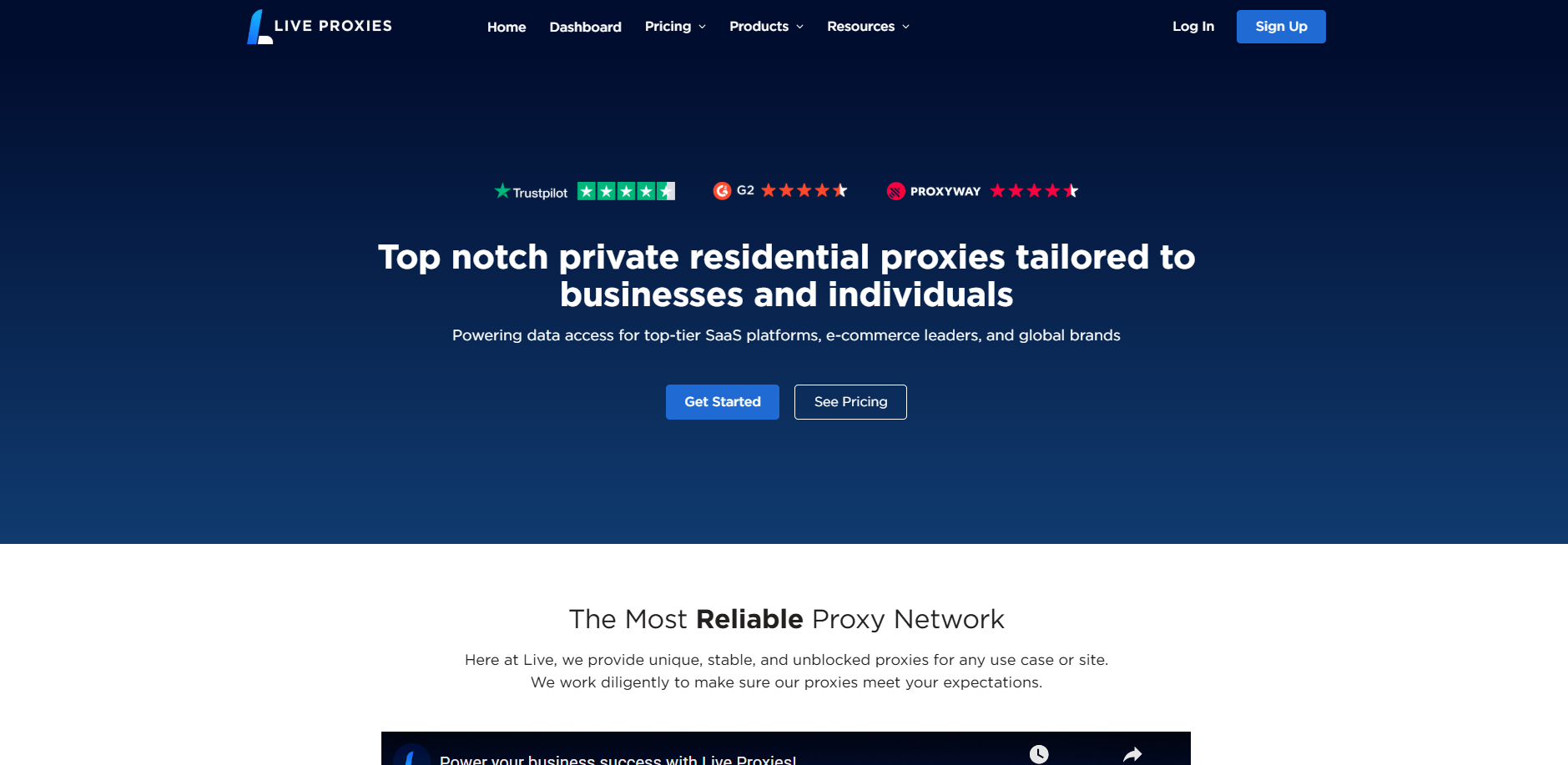
AI data collection becomes unreliable when crawlers hit blocked pages, lose session continuity, or collect the wrong local version of a source. Live Proxies is built for workflows where proxy quality directly affects whether SERP data, ecommerce pages, ads, reviews, and competitor sources become usable AI input.
For teams that need reliable residential proxies for AI data collection, Live Proxies combines private IP allocation, target-based IP separation, rotating residential and mobile infrastructure, unlimited threads, sticky sessions up to 24 hours, and country, city, and ASN targeting. Its infrastructure supports repeatable public web data workflows where teams need cleaner access logic, stable sessions, and more accurate localized datasets.
Private IP allocation: Helps reduce IP overlap and supports cleaner routing for recurring AI data collection.
Target-based IP separation: Allows teams to separate proxy allocation by target for SERP, ecommerce, marketplace, and competitor workflows.
Rotating residential and mobile proxies: Supports both trust-sensitive public web sources and mobile-first data collection.
Sticky sessions up to 24 hours: Enables crawlers to maintain continuity across pagination, filters, repeated checks, and multi-step workflows.
Country, city, and ASN targeting: Improves dataset accuracy when AI teams need localized SERPs, pricing, ads, or market signals.
Coverage and IP pool: Millions of IPs across 55 countries, with especially strong availability in the United States, Canada, and the United Kingdom.
Enterprise-oriented trial access: Free trial options are primarily available on enterprise plans rather than for tiny teams.
Built for recurring workflows: The platform is more suitable for ongoing AI data collection than occasional low-volume crawling.
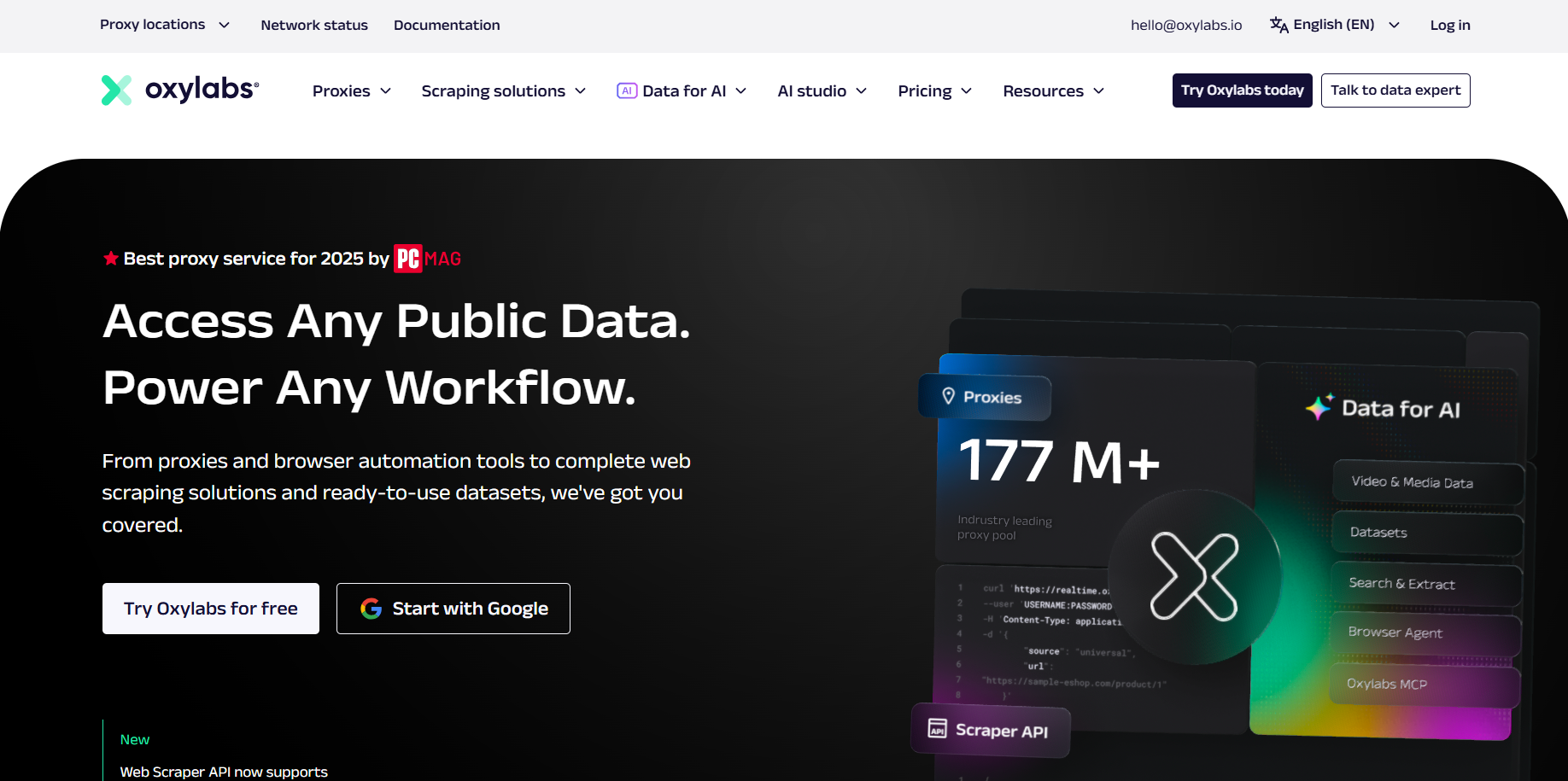
Oxylabs is built for AI teams that need public web data at enterprise scale. It is a strong fit when data collection involves large target lists, structured extraction, automated scraping, and high-volume workflows across ecommerce, search, marketplace, and public web sources.
The platform is not just a proxy provider. It also offers scraping APIs and unblocking tools, which make it useful for AI teams that want to reduce the amount of crawler logic they manage internally. This makes Oxylabs especially relevant for organizations that need proxy infrastructure and data extraction support in one enterprise-grade workflow.
Enterprise-scale infrastructure: Supports large public data collection projects across many sources and regions.
Broad proxy portfolio: Residential, mobile, ISP, datacenter, dedicated datacenter, and dedicated ISP options help match infrastructure to different data sources.
Advanced geo-targeting: Country, city, state, ZIP, ASN, and other filters support localized AI datasets.
Scraping APIs: Web Scraper API and related tools help turn public pages into more structured data.
Web Unblocker: Helps teams manage access challenges in complex public web data workflows.
AI data fit: Useful for model training data, RAG enrichment, search data, ecommerce data, and large-scale market intelligence.
Can be heavy for smaller teams: The setup may be more complex than needed for small AI data collection tests.
Higher enterprise focus: The strongest value appears when teams need scale, APIs, and managed infrastructure.
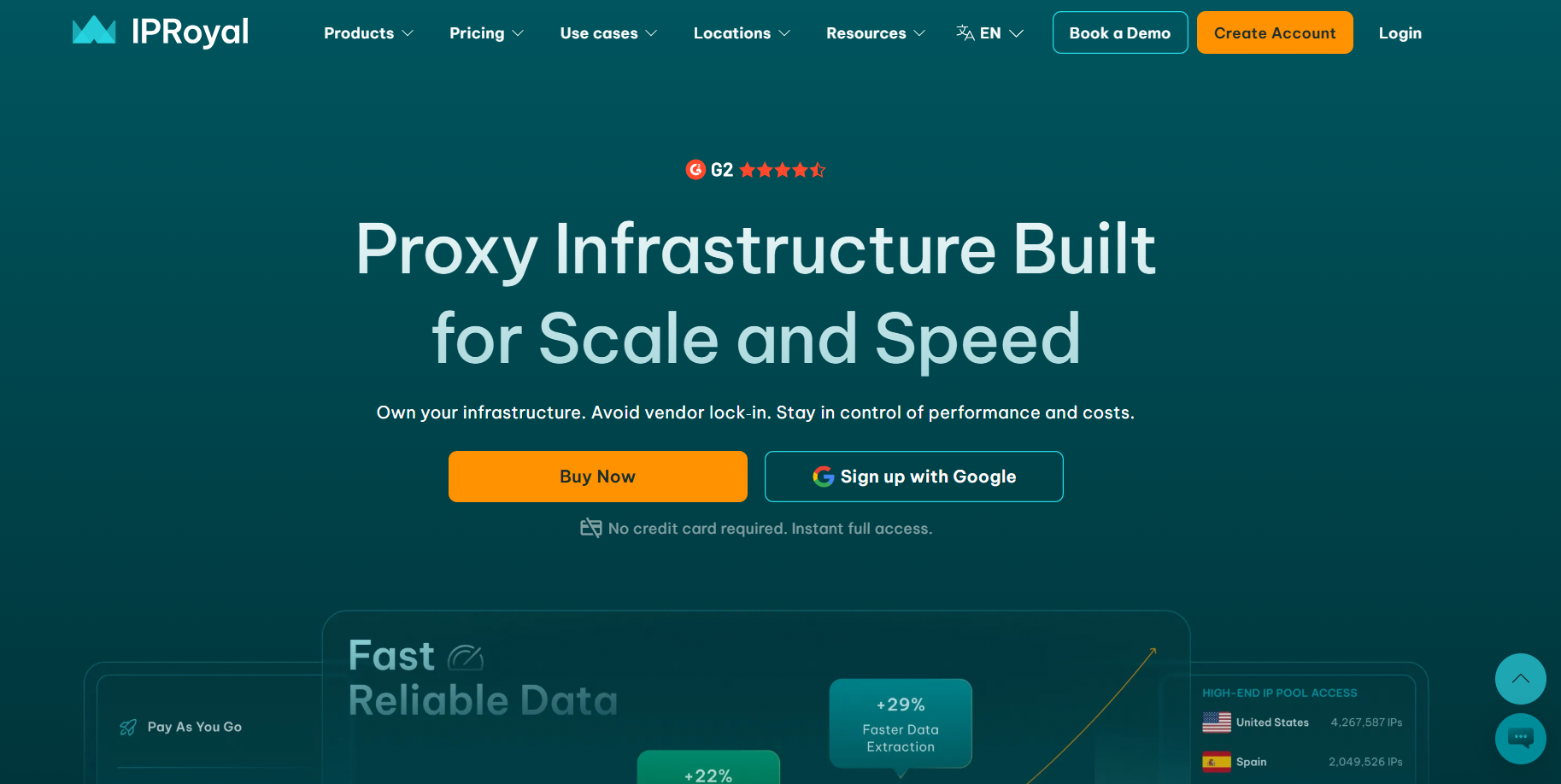
IPRoyal is a practical option for AI teams that need flexible proxy access without starting with a large enterprise stack. It works well for controlled-budget workflows such as SERP checks, ecommerce tracking, competitor monitoring, public reviews, and smaller scraping projects.
Its main strength is accessibility. Teams can use different proxy types, manage traffic more flexibly, and run real AI data collection workflows without committing to a complex infrastructure setup from the start. This makes IPRoyal a useful fit for teams that are testing AI data pipelines, scaling gradually, or keeping infrastructure costs predictable.
Flexible traffic purchasing: Helps teams control costs when data volume changes by project.
Multiple proxy types: Residential, mobile, ISP, and datacenter proxies support different AI collection needs.
Country, state, and city targeting: Useful for localized SERP data, ecommerce checks, and regional market research.
Rotating and sticky sessions: Supports both broader crawling and repeated checks.
HTTP(S) and SOCKS5 support: Makes integration easier with crawlers, browsers, scripts, and automation tools.
Simple dashboard: Helps smaller teams manage proxy setup without heavy operational complexity.
Less advanced for enterprise AI pipelines: Large-scale data operations may need deeper scraping tools and managed infrastructure.
Better for controlled-budget workflows: It is stronger for flexible collection than for highly complex AI data ecosystems.
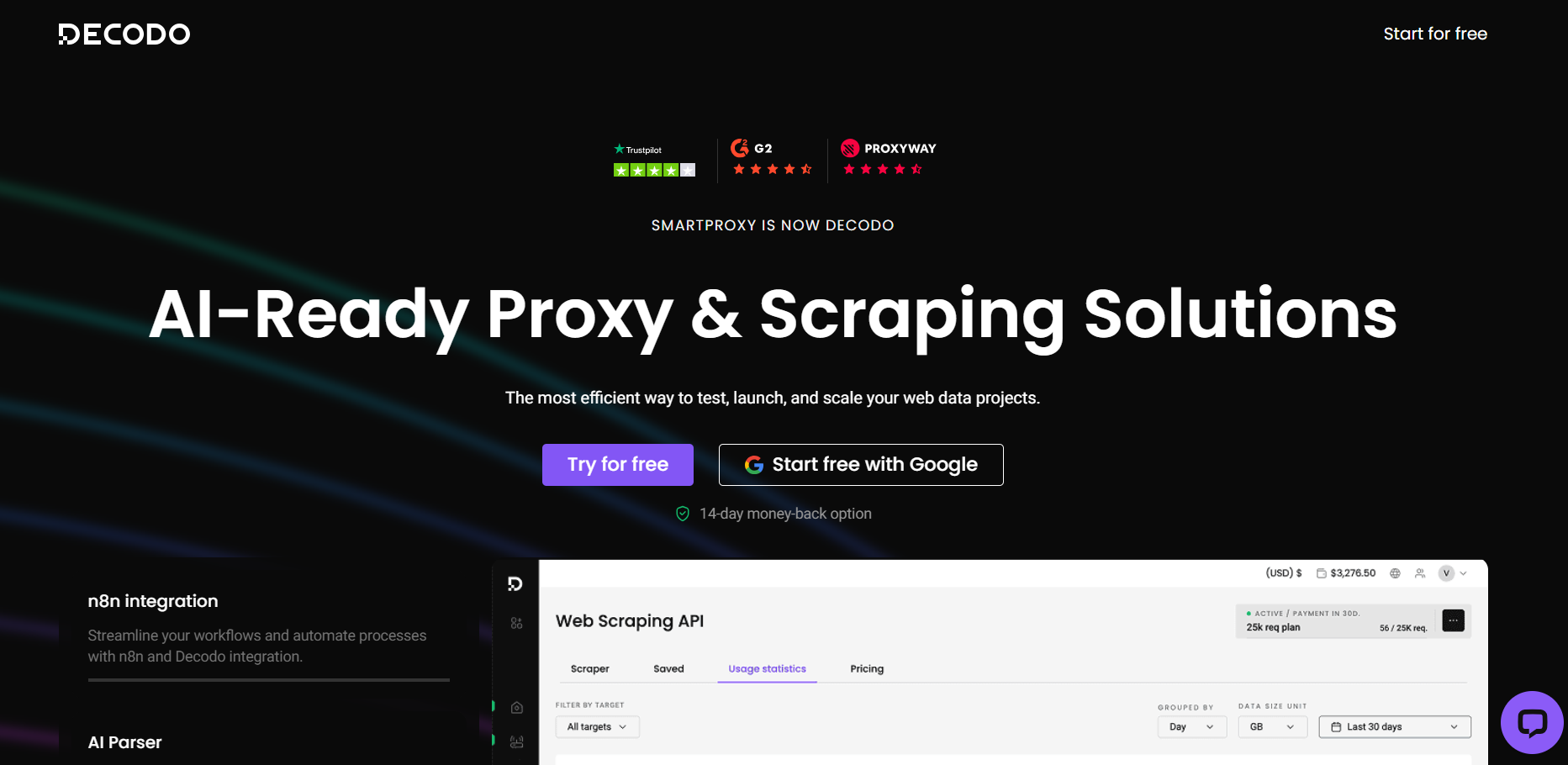
Decodo works well for AI teams that need flexible scraping workflows and a manageable setup. It gives growing teams a mix of proxy types, targeting controls, session options, APIs, and integrations for recurring public data collection across search, ecommerce, competitor, and market research sources.
The platform is useful when AI data workflows change by project. A team may use one setup for SERP datasets, another for e-commerce monitoring, and another for market intelligence, which makes Decodo a practical middle ground between basic proxies and enterprise-heavy systems. This flexibility helps teams scale AI data collection without rebuilding their proxy setup for every new workflow.
Flexible proxy infrastructure: Residential, mobile, ISP, static residential, and datacenter proxies support different AI data sources.
Geo-targeting controls: Country, city, ZIP, ASN, and related filters help improve localized dataset accuracy.
Rotating and sticky sessions: Teams can switch between broad crawling and stable repeated access.
HTTP(S) and SOCKS5 support: Works with scraping tools, browsers, bots, scripts, and custom crawlers.
Scraping APIs: API tools help simplify public data collection and reduce manual infrastructure work.
Good usability-to-scale balance: Useful for teams moving from manual collection to automated AI data workflows.
Less enterprise-heavy than Oxylabs: Very large AI data operations may need deeper managed infrastructure.
Requires workflow planning: Teams still need to choose the right mix of proxies, APIs, targeting, and session settings.
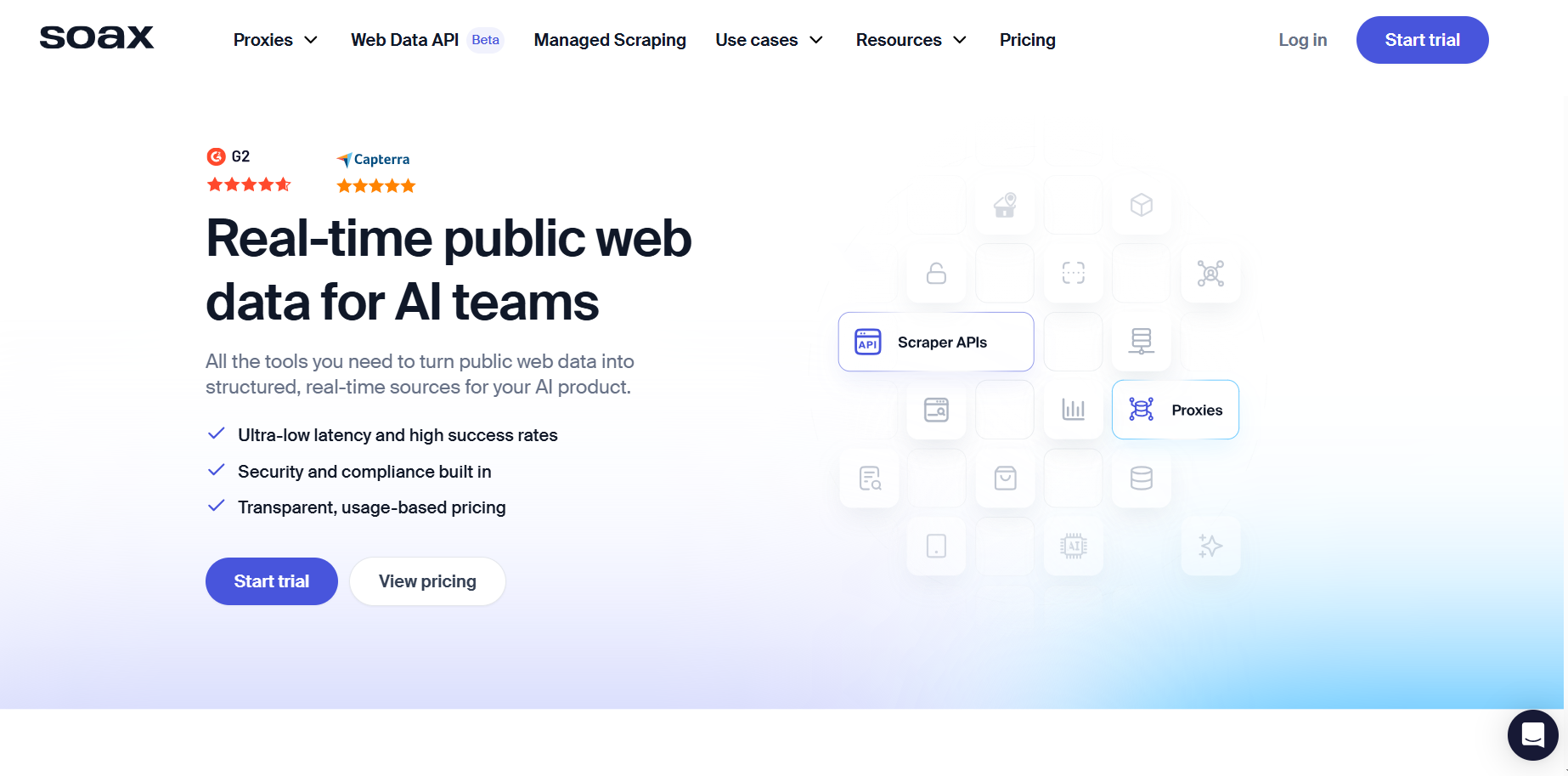
SOAX is a strong fit for AI datasets where location accuracy matters. It is especially useful when teams collect local SERPs, regional pricing, marketplace pages, ads, or competitor visibility data that changes by country, city, region, or ISP.
This provider works best when geo context is part of the dataset, not just a technical filter. For AI systems that depend on localized inputs, SOAX helps teams collect market-specific data with more control over where requests appear to come from. This makes it valuable for workflows where small regional differences can affect rankings, prices, availability, or market insights.
Geo-focused infrastructure: Strong fit for datasets where local accuracy affects final data quality.
Country, region, city, and ISP targeting: Helps AI teams collect more accurate regional results.
Flexible rotation controls: Supports both broad sampling and repeated local checks.
Residential, mobile, ISP, and datacenter access: Gives teams options for different levels of trust, speed, and stability.
Web Data API: Helps reduce manual collection work for public web data projects.
Enterprise pricing: High-volume teams can access enterprise proxy rates starting at $0.32/GB.
Plan selection matters: High-volume AI data collection requires careful traffic and pricing planning.
Most useful for geo-sensitive data: Teams focused only on simple bulk crawling may not need its full location controls.
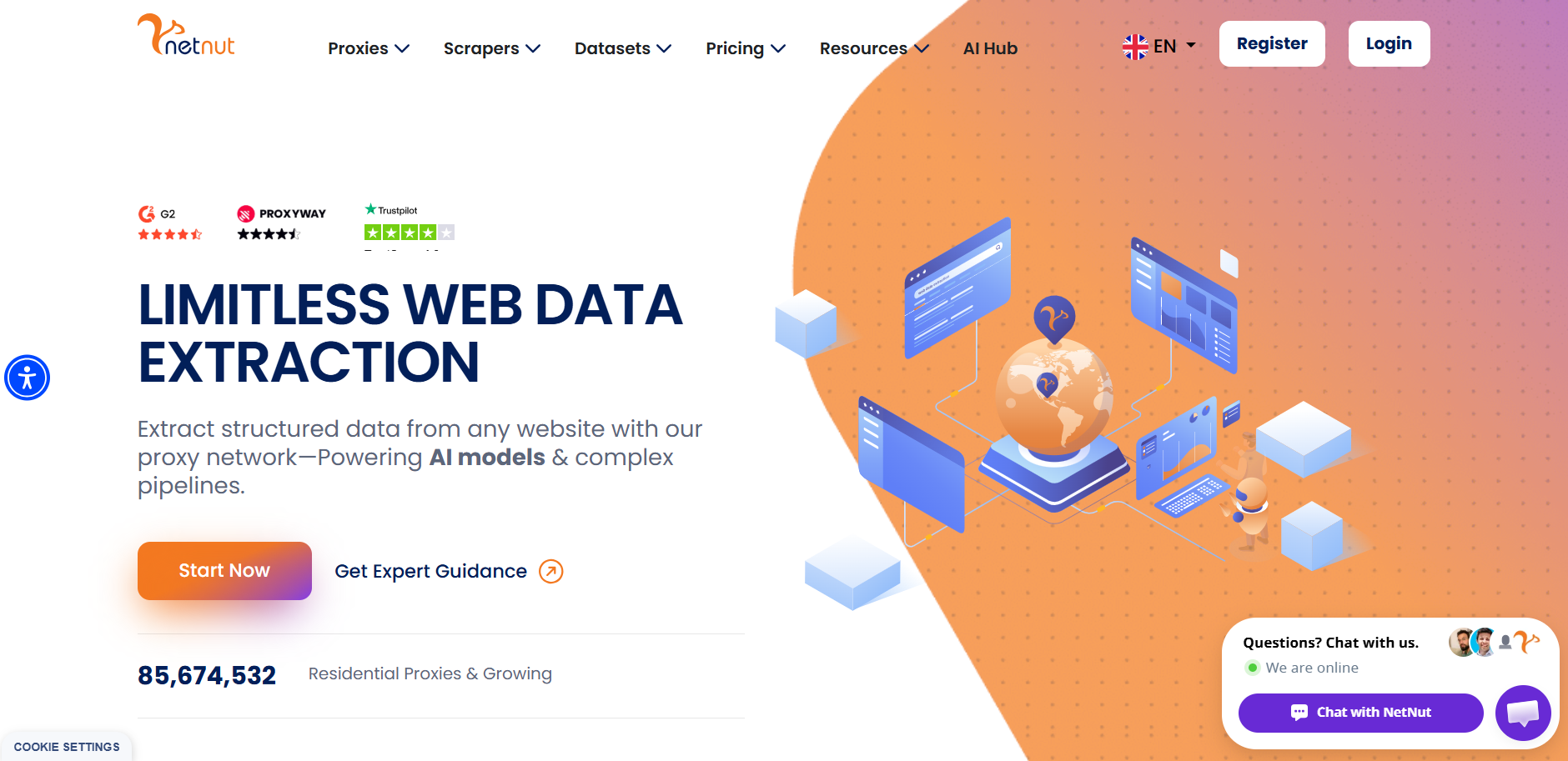
NetNut is a good option for teams that need stable recurring access rather than occasional scraping. It fits AI enrichment, review monitoring, ecommerce tracking, competitor intelligence, and long-running public data workflows.
The platform is more relevant for mature data teams that already know what they need to collect and how often. Its value comes from supporting ongoing collection and monitoring rather than lightweight experimentation.
Business-oriented infrastructure: Designed for teams that need reliable proxy operations over time.
Residential proxy network: Supports public data collection, e-commerce monitoring, and market intelligence workflows.
Static residential options: Useful for stable sessions, account-based flows, and long-term scraping tasks.
Mobile proxies: Help with mobile SERPs, app-related signals, mobile ads, and mobile-specific datasets.
Rotating sessions: Support broader collection across many sources and markets.
Good fit for recurring workflows: Useful for AI enrichment, review tracking, and market monitoring schedules.
Less beginner-friendly: Better suited for teams with clear data collection requirements.
Not the simplest testing option: Small teams may need time to match products and sessions to their workflow.
Webshare is a good fit for budget-conscious AI teams that need simple proxy access for smaller scraping projects, prototype pipelines, and workflow testing. It is not the deepest enterprise platform, but it can help teams validate target lists, scripts, crawler behavior, and collection logic before scaling.
Its value is simplicity. Webshare gives teams a low-friction way to start collecting public data without building a complex proxy stack from the beginning. This makes it useful for early-stage AI data workflows where teams need practical access, basic automation support, and predictable entry-level costs.
Low entry pricing: Useful for smaller teams and early-stage AI data collection.
Simple dashboard: Makes proxy management easier for users who do not need enterprise controls.
API access: Helps connect proxies with crawlers, scripts, and automation workflows.
Rotating residential proxies: Useful for smaller scraping tasks, SERP checks, ecommerce monitoring, and public data collection.
Static residential proxies: Help with repeated checks and workflows that need a more stable identity.
Datacenter proxies: Support faster, lower-cost testing and bulk checks on less protected sources.
Not ideal for complex enterprise AI pipelines: Larger operations may need stronger session control, deeper targeting, and managed support.
Best for testing and smaller workflows: Webshare is stronger for prototypes and lightweight crawls than advanced AI data infrastructure.
Different AI workloads need different proxy types because each data source has its own access patterns, detection risks, and accuracy requirements. The best choice depends on target sensitivity, data volume, session requirements, crawl frequency, and whether the dataset must be localized by country, city, carrier, or market.
Residential proxies are best for trust-sensitive websites because they use real household IP addresses. They are useful for collecting SERPs, ecommerce pages, reviews, directories, local listings, and public content where datacenter traffic is more likely to be flagged.
Mobile proxies are best for mobile-first data. They help AI teams collect content that may change by carrier, device environment, mobile network, app context, or mobile search behavior. This supports cleaner mobile datasets for apps, ads, and SERPs.
ISP proxies are useful when AI teams need stable recurring sessions with strong performance. They combine consistent routing with higher trust than standard datacenter IPs, making them suitable for repeated checks and long-running monitoring workflows. They also help preserve consistency across scheduled crawls and comparisons.
Datacenter proxies are best for speed, scale, and lower costs. They work well for low-risk sources, internal testing, parser validation, and high-volume requests where IP trust is less important. They are strongest when targets are open, simple, and predictable.
Rotating proxies are best for large crawling jobs because they distribute requests across many IPs. They help teams collect data from many pages, categories, products, markets, or sources without relying on one IP identity. This makes them useful for broad sampling and large-scale discovery.
AI teams need proxies most when workflows depend on public web data, location accuracy, repeated collection, or large-scale crawling. Proxies help keep these workflows stable when teams collect SERPs, ecommerce pages, reviews, ads, market signals, or localized content across different regions and time periods.
LLM training and RAG enrichment: Proxies help collect public web content for domain-specific corpora, retrieval systems, and updated knowledge bases.
SERP monitoring: AI search, SEO, and market visibility workflows need localized search data across countries, cities, devices, and markets.
E-commerce intelligence: Teams can track product prices, availability, reviews, category rankings, seller data, and catalog changes.
Competitor and market research: Proxies help monitor competitor pages, offers, content, rankings, market positioning, and regional demand signals.
Ad verification and trend detection: Teams can validate ad placement, campaign visibility, public interest shifts, product trends, and localized content changes.
Weak proxies can damage AI datasets before the model, crawler pipeline, or retrieval system ever uses the data. If crawlers collect blocked pages, wrong geo results, duplicate records, error pages, or incomplete HTML, the final dataset becomes less reliable and harder to clean.
Weak proxies can fail to reach important URLs, product pages, listings, reviews, search results, or category pages. This creates gaps in training, enrichment, analytics, market research, and monitoring datasets, especially when collection jobs need broad coverage across many sources.
Poor targeting can collect data from the wrong country, city, storefront, language version, or search environment. For AI teams, this can distort localized SERPs, ecommerce pricing, ad visibility, product availability, and regional market signals.
Low-quality IPs often trigger blocks, redirects, verification challenges, throttling, and access interruptions. This increases failure rates, slows down crawlers, and makes long-running public data collection jobs harder to complete consistently.
Aggressive or unstable rotation can break multi-step workflows, filters, pagination, carts, account-free browsing paths, and repeated checks. As a result, crawlers may collect partial records, lose continuity, or fail before completing the full data flow.
Duplicate records, error pages, partial content, corrupted responses, and mismatched locations can weaken downstream AI systems. Bad input data can affect model answers, retrieval results, analytics, product insights, and business decisions.
AI teams need proxy workflows that protect both data quality and responsible collection practices. This means checking not only access rates, but also sourcing, monitoring, validation, and auditability.
Public data boundaries: Teams should collect only public web data, avoid sensitive personal data, and respect website rules, access limits, and legal requirements.
Provider sourcing checks: Proxy sourcing matters for AI data operations. Teams should review whether providers use ethical, consent-based networks that fit business compliance needs.
Crawl monitoring: Teams should track failed requests, blocked responses, redirects, geo mismatches, and session drops to catch data quality problems early.
Dataset validation: Before using data for training, enrichment, or retrieval, teams should remove duplicates, corrupted fields, incomplete pages, and location-mismatched results.
Auditability: Logs help teams understand how data was collected, which regions were used, which sessions failed, and whether repeated crawls stayed consistent.
AI data collection depends on reliable access, clean routing, accurate localization, and repeatable crawl logic. Weak proxies can create missing pages, wrong geo results, failed crawls, duplicate records, and noisy datasets that weaken training, enrichment, retrieval, and analytics workflows.
The best proxy setup helps teams collect public web data consistently across SERPs, ecommerce pages, ads, marketplaces, reviews, and competitor sources. The right provider should match the dataset size, target websites, compliance requirements, location needs, session logic, and collection frequency behind the AI workflow.
 AI tools to find & convert leads.
  Send emails at scale